2-Methyl-1,3-Butadiene Price Trend and Forecast
2-Methyl-1,3-Butadiene Regional Price Overview
Get the latest insights on price movement and trend analysis of 2-Methyl-1,3-Butadiene in different regions across the world (Asia, Europe, North America, Latin America, and the Middle East & Africa).
2-Methyl-1,3-Butadiene (Isoprene) Price Trend Analysis for the Year 2024
Asia
Throughout 2024, the Asian 2-Methyl-1,3-Butadiene market exhibited fluctuating trends. The first quarter began with declining prices as the Chinese market experienced subdued automotive demand coupled with excess inventory. The second quarter witnessed an upward movement due to rising feedstock costs and heightened demand from automotive and tire sectors, particularly in Japan.
2-Methyl-1,3-Butadiene Price Chart
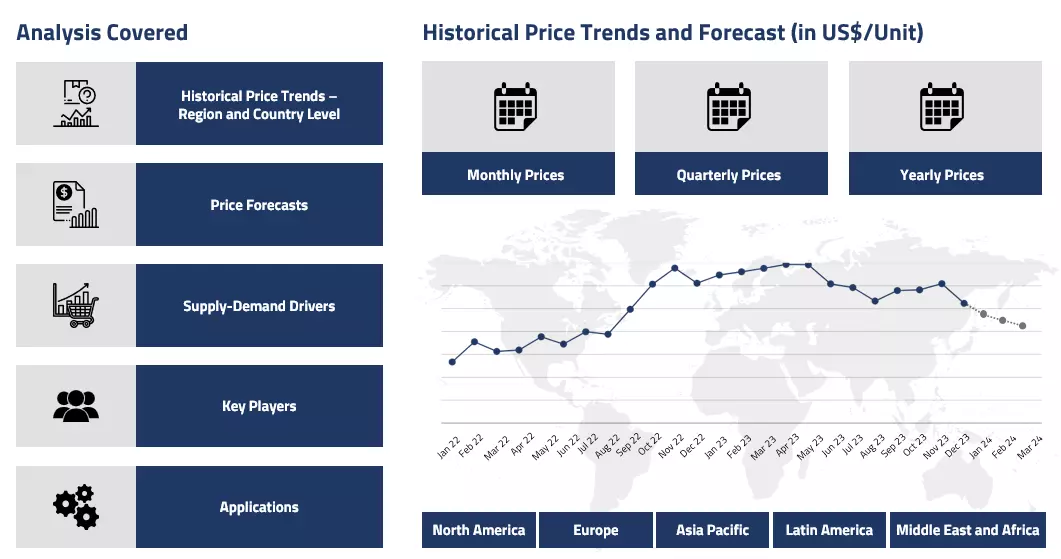
Please Login or Subscribe to Access the 2-Methyl-1,3-Butadiene Price Chart Data
The third quarter continued this momentum with notable increases compared to Q2, driven by insufficient inventory and rising production costs. The final quarter turned bearish, especially in Japan, as the automotive sector underperformed amid economic uncertainties and earthquake-related logistical challenges.
Europe
The European 2-Methyl-1,3-Butadiene market demonstrated resilience throughout 2024, beginning with a robust first quarter that saw significant increases from the previous quarter. This surge was driven by strong automotive demand and rising energy costs. The second quarter continued upward, supported by tire sector demand and the ECB's rate cuts facilitating industrial investment. The third quarter saw further increases reflecting sustained demand, while Q4 exhibited persistent bearish trends due to subdued trading and limited downstream activity despite occasional bullish momentum from automotive sectors.
North America
The North American 2-Methyl-1,3-Butadiene market experienced a volatile year. Q1 showed substantial price increases compared to the previous quarter, driven by strong automotive demand and higher operating costs. The second quarter reversed this trend with declining prices due to sluggish downstream demand and high inventory levels. The third quarter initially declined due to inventory accumulation but later improved with heightened supplier activity and rising butadiene feedstock costs.
The Federal Reserve's interest rate cut by 50 basis points provided some economic stability. The fourth quarter showed mixed performance with modest resilience despite challenges from port strikes along the East and Gulf Coasts, which constrained the supply chain.
Analyst Insight
The 2-Methyl-1,3-Butadiene market is expected to maintain cautious stability in 2025, with prices closely tracking automotive industry performance and feedstock costs. Regional disparities will likely persist, with Asia potentially seeing faster recovery contingent on improved consumer confidence and supply chain normalization.
2-Methyl-1,3-Butadiene Price Trend for the Second Half of 2023
Asia
In Asia, 2-Methyl-1,3-Butadiene (Isoprene) prices showed a mixed trend during the second half of 2023. In Q3, the market experienced price fluctuations with an initial decline followed by recovery toward the end of the quarter. Chinese producers saw increased feedstock costs for C5 fractions and naphtha, which supported price stabilization.
Demand from the synthetic rubber industry remained moderate, with tire manufacturers operating at reduced capacities due to economic uncertainties. In Q4, the market stabilized with slight upward movement as supply tightened following scheduled maintenance at key production facilities in South Korea and Japan. However, overall demand remained subdued compared to previous years, preventing significant price gains despite the constrained supply situation.
Europe
The European market faced challenges throughout H2’23. During Q3, prices declined as manufacturers struggled with weak consumer confidence and limited sales. Production costs remained elevated due to high energy prices, putting pressure on margins. By Q4, the situation improved modestly as naphtha costs increased consistently, providing upward momentum for Isoprene prices.
The automotive sector, a key consumer of synthetic rubber made from Isoprene, showed tentative signs of recovery, helping stabilize demand. However, competition from cheaper Asian imports continued to limit pricing power for European producers. The market ended the year with prices plateauing, reflecting the balance between improved demand and persistent economic headwinds across the region.
North America
In North America, the Isoprene market experienced significant volatility during H2’23. Q3 began with downward price pressure as domestic producers faced competition from cheaper Asian imports. Inventories initially depleted quickly due to supply-demand imbalances, but increased imports soon drove prices lower. The start of Q4 brought positive momentum with dramatic price increases supported by rising energy costs, increased procurement from tire manufacturers, and reduced production rates. The synthetic rubber industry, particularly manufacturers of specialty elastomers, increased their acquisition rates to secure material ahead of anticipated winter shortages. By year-end, the market had stabilized at higher levels compared to mid-year, reflecting the improved demand situation and controlled supply availability.
Analyst Insight
According to Procurement Resource, 2-Methyl-1,3-Butadiene (Isoprene) prices are expected to remain relatively stable in early 2024, with the recent price increases likely normalizing after the winter season. Demand from the rubber industry will be the key factor determining price direction, with automotive sector performance playing a crucial role in consumption patterns.
2-Methyl-1,3-Butadiene Price Trend for the First Half of 2023
Asia
2-Methyl-1,3-Butadiene prices in the Asian market continued with oscillating patterns in H1’23. As the market began to recover from the lockdown aftereffects, some inclination was observed in the first month of Q1. But holidays for Chinese New Year hindered the recovery, and demands stooped back, which brought the price trend down again.
After the holiday season, factories started churning out the product much faster, oversupplying the inventories, but market demands didn’t rebound to supplement the increased production rates. These events made the 2-Methyl-1,3-Butadiene /Isoprene falter throughout the second quarter. Overall bearish market sentiments were observed.
Europe
2-Methyl-1,3-Butadiene prices fluctuated in the first half of the year 2023 in the European market. The market was saturated with rubber products and demands from the downstream automotive and tire industries remained bearish. Inventories had no room for more supplies amidst limited offtakes. Improved supplies with freight restoration also couldn’t help the market much. Occasional demands appeared, but existing stocks easily catered to those. Overall, the Isoprene market sentiments remained bearish.
North America
The North American Isoprene market struggled throughout the said period. Increased interest rates impacted the automotive sector severely, reducing the queries for 2-Methyl-1,3-Butadiene in the American market. Heavy inventory volumes, too, contributed to keeping the price trend sluggish. Some occasional temporary upturns in demand were observed but could not influence the price trend positively. Prices returned to the downhill track after very short-lived hikes. Overall, bearish market sentiments were observed in the first half of 2023.
Analyst Insight
According to Procurement Resource, the price trend for 2-Methyl-1,3-Butadiene are expected to continue the same sluggish patterns given the overstocked inventories. Market demand will remain the primary driving force, and any rebound in price trend only seems possible with improvement in market offtakes.
Procurement Resource provides latest prices of 2-Methyl-1,3-Butadiene. Each price database is tied to a user-friendly graphing tool dating back to 2014, which provides a range of functionalities: configuration of price series over user defined time period; comparison of product movements across countries; customisation of price currencies and unit; extraction of price data as excel files to be used offline.
Our Clients


Procurement Resource Database

Turn price intelligence into action with the Procurement Resource Database. Log in or subscribe to unlock live price trends, historical charts, supplier databases, cost curves, and analyst-backed insights across chemicals, agriculture, energy, packaging, and more. Use these tools to benchmark your contracts, plan budgets with confidence, and stay ahead of market moves on every product you buy.
2-Methyl-1,3-Butadiene Dashboard Inclusions

0
+Products
0
+Regions
0
+Subscriptions
About 2-Methyl-1,3-Butadiene
Isoprene is a fairly common organic compound that is also known as 2-methyl-1,3-butadiene. In its pure form, it is a colourless volatile liquid. Isoprene is an unsaturated hydrocarbon. It is produced by many plants and animals, and its polymers are the principle component of natural rubber.
2-Methyl-1,3-Butadiene Product Details
| Report Features | Details |
| Product Name | 2-Methyl-1,3-Butadiene |
| Industrial Uses | Tires, Healthcare, Apparel and footwear |
| Chemical Formula | C5H8 |
| Synonyms | Isoprene |
| Molecular Weight | 68.12 g/mol |
| Supplier Database | The Goodyear Tire & Rubber Company, Royal Dutch Shell Plc, Kuraray Co. Ltd., ZEON Corporation, LyondellBasell Industries N.V. |
| Region/Countries Covered | Asia Pacific: China, India, Indonesia, Pakistan, Bangladesh, Japan, Philippines, Vietnam, Iran, Thailand, South Korea, Iraq, Saudi Arabia, Malaysia, Nepal, Taiwan, Sri Lanka, UAE, Israel, Hongkong, Singapore, Oman, Kuwait, Qatar, Australia, and New Zealand Europe: Germany, France, United Kingdom, Italy, Spain, Russia, Turkey, Netherlands, Poland, Sweden, Belgium, Austria, Ireland Switzerland, Norway, Denmark, Romania, Finland, Czech Republic, Portugal and Greece North America: United States and Canada Latin America: Brazil, Mexico, Argentina, Columbia, Chile, Ecuador, and Peru Africa: South Africa, Nigeria, Egypt, Algeria, Morocco |
| Currency | US$ (Data can also be provided in local currency) |
| Supplier Database Availability | Yes |
| Customization Scope | The report can be customized as per the requirements of the customer |
| Post-Sale Analyst Support | 360-degree analyst support after report delivery |
Note: Our supplier search experts can assist your procurement teams in compiling and validating a list of suppliers indicating they have products, services, and capabilities that meet your company's needs.
2-Methyl-1,3-Butadiene Production Processes
- Production of 2-Methyl-1,3-Butadiene Production from Naphtha (or oil) via Thermal Cracking
Thermal cracking of naphtha occurs in this process to produce 2-methyl-1,3-butadiene.
Methodology
The displayed pricing data is derived through weighted average purchase price, including contract and spot transactions at the specified locations unless otherwise stated. The information provided comes from the compilation and processing of commercial data officially reported for each nation (i.e. government agencies, external trade bodies, and industry publications).
Our Price Analysis Methodology


Schedule A Demo
Experience how Procurement Resource transforms raw material price data into clear, decision ready intelligence. Optimise your performance with reliable, expert market data and analysis. Schedule your demo today to experience a live walk-through where our experts will showcase interactive price charts, forecasted prices, and insights driving the prices for your key commodities, tailored to your workflows. Contact us now!
Our Team will be happy to assist you
We are just a text away
Still Need Help ?
Europe & Africa
+44 7573 171117
Sales@prourementresource.com
USA & Canada
+1 307 363 1045
Sales@prourementresource.com
APAC
+91 8850629517
Sales@prourementresource.com
Subscription Plans
Unlock full access to Procurement Resource's price databases, interactive charts, and short-term forecasts for thousands of commodities. Elevate your sourcing decisions by comparing prices across regions, downloading historical data, and layering in analyst-backed insights, all with our flexible plans that scale as your portfolio grows.
Still have any Questions
Contact Us


Price Trend Dashboard - What's Included
Price trends across a diverse portfolio of categories and products, spanning board to niche chemicals
Coverage extendable to grade-specific chemicals based on procurement requirements
Regular price tracking supported by robust historical datasets
News, policy updates, and key market drivers impacting price movements
Short-term and long-term price outlooks and forecasts
Supply–demand dynamics and capacity-driven market analysis
- Unlimited Users
- Historical Monthly Price
- USA, Europe, APAC Covered
- Monthly Forecast
- 12 Months validity
- News & Events
- 50 Products (Refer Next Page For List)
Why Procurement Database

Assistance from Experts
Throughout 2024, the Asian acetoin market experienced fluctuating trends with regional variations. Q1 began with moderate price increases driven by supply constraints from Chang Chun Plastics' maintenance shutdown in Taiwan. Post-S...

Client's Satisfaction
Throughout 2024, the Asian acetoin market experienced fluctuating trends with regional variations. Q1 began with moderate price increases driven by supply constraints from Chang Chun Plastics' maintenance shutdown in Taiwan. Post-S...

Assured Collaboration
Throughout 2024, the Asian acetoin market experienced fluctuating trends with regional variations. Q1 began with moderate price increases driven by supply constraints from Chang Chun Plastics' maintenance shutdown in Taiwan. Post-S...
Global Insights
Throughout 2024, the Asian acetoin market experienced fluctuating trends with regional variations. Q1 began with moderate price increases driven by supply constraints from Chang Chun Plastics' maintenance shutdown in Taiwan. Post-S...
1/4