Behenyl Alcohol Price Trend and Forecast
Behenyl Alcohol Regional Price Overview
Get comprehensive insights into the Behenyl Alcohol market, with a focused analysis of the Behenyl Alcohol price trend across Asia, Europe, North America, Latin America, and the Middle East & Africa.
Behenyl Alcohol Price Trend for the Second Half of 2024
Asia
During the latter half of 2024, the Behenyl Alcohol price curve exhibited mixed trends in the Asian markets. Behenyl Alcohol is produced through the hydrogenation of plant oils such as rapeseed oil, soybean oil, and peanut oil. As a result, its price trend closely followed that of its feedstocks during this period.
Behenyl Alcohol Price Chart
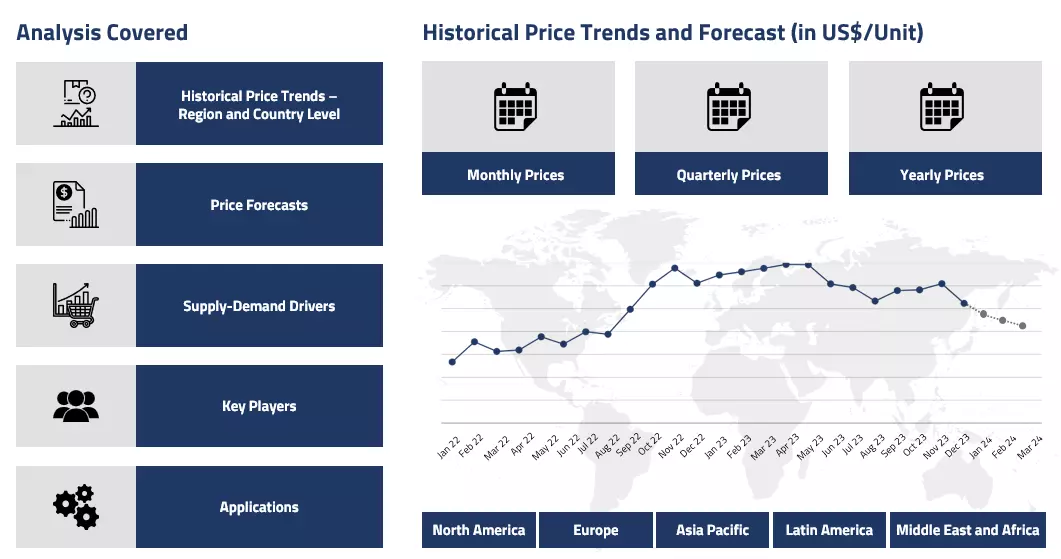
Please Login or Subscribe to Access the Behenyl Alcohol Price Chart Data
In the early part of the quarter, Behenyl Alcohol prices remained range-bound as demand and supply were relatively balanced. Additionally, the upstream market experienced minimal fluctuations during the first two months of the period. However, in September, prices were more forward looking as rapeseed oil costs surged due to limited availability in the market. This increase in production costs was reflected in retail prices. After peaking in November, prices declined as upstream costs stabilized.
Meanwhile, in the Indian market, Behenyl Alcohol prices fluctuated throughout the quarter. Initially, prices moved within a narrow range before experiencing a sharp increase due to rising upstream costs. However, towards the end of the quarter, prices stabilized as market conditions normalized.
Europe
The Behenyl Alcohol price curve in Europe closely followed the trend observed in Asian markets, primarily influenced by feedstock prices during the second half of 2024. Fluctuating production costs and lingering logistical issues shaped market sentiment, while variations in upstream costs added further complexity.
Europe faced unique challenges, including unexpected weather conditions that affected crop yields in key growing regions. This resulted in supply shortages, leading to intermittent price increases in the middle of the period. Additionally, the European market contended with higher energy costs and inflationary pressures, further driving up production expenses. However, towards the end of the period, prices began stabilizing as upstream industries adjusted to these challenges.
North America
In H2’24, the prices of Behenyl Alcohol in the North American markets mirrored the trend of the other global markets, particularly the Chinese markets. The industry saw a combination of rising prices due to reduced supply and periods of stabilization as new harvests entered the market. Additionally, North American demand remained steady, driven by both domestic consumption and export requirements.
Analyst Insight
According to Procurement Resource, the Behenyl Alcohol price curve is expected to show slight improvements in the prices primarily influenced by the feedstock costs.
Procurement Resource provides latest prices of Behenyl Alcohol. Each price database is tied to a user-friendly graphing tool dating back to 2014, which provides a range of functionalities: configuration of price series over user defined time period; comparison of product movements across countries; customisation of price currencies and unit; extraction of price data as excel files to be used offline.
Our Clients


Procurement Resource Database

Turn price intelligence into action with the Procurement Resource Database. Log in or subscribe to unlock live price trends, historical charts, supplier databases, cost curves, and analyst-backed insights across chemicals, agriculture, energy, packaging, and more. Use these tools to benchmark your contracts, plan budgets with confidence, and stay ahead of market moves on every product you buy.
Behenyl Alcohol Dashboard Inclusions

0
+Products
0
+Regions
0
+Subscriptions
About Behenyl Alcohol
Behenyl alcohol is a long-chain fatty alcohol, typically derived from natural sources like rapeseed oil or peanuts. It is a waxy, white solid at room temperature with the chemical formula C22H46O. Behenyl alcohol has a high melting point and is known for its stable chemical structure. It is considered a saturated alcohol with a relatively simple molecular composition. This compound is part of a group of fatty alcohols and is often used as a building block in the production of various derivatives.
Behenyl Alcohol Product Details
| Report Features | Details |
| Product Name | Behenyl Alcohol |
| Chemical Formula | C22H46O |
| CAS number | 661-19-8 |
| HS Code | 29239000 |
| Molecular Weight | 326.6 g/mol |
| Synonyms | Docosanol |
| Supplier Database | BASF SE, Godrej Industries, Jarchem Industries Inc., Kao Corporation, Kokyu Alcohol Kogyo Co.Ltd., Koster Keunen, New Japan Chemical Co. Ltd. |
| Region/Countries Covered | Asia Pacific: China, India, Indonesia, Pakistan, Bangladesh, Japan, Philippines, Vietnam, Iran, Thailand, South Korea, Iraq, Saudi Arabia, Malaysia, Nepal, Taiwan, Sri Lanka, UAE, Israel, Hongkong, Singapore, Oman, Kuwait, Qatar, Australia, and New Zealand Europe: Germany, France, United Kingdom, Italy, Spain, Russia, Turkey, Netherlands, Poland, Sweden, Belgium, Austria, Ireland Switzerland, Norway, Denmark, Romania, Finland, Czech Republic, Portugal and Greece North America: United States and Canada Latin America: Brazil, Mexico, Argentina, Columbia, Chile, Ecuador, and Peru Africa: South Africa, Nigeria, Egypt, Algeria, Morocco |
| Currency | US$ (Data can also be provided in local currency) |
| Supplier Database Availability | Yes |
| Customization Scope | The report can be customized as per the requirements of the customer |
| Post-Sale Analyst Support | 360-degree analyst support after report delivery |
Note: Our supplier search experts can assist your procurement teams in compiling and validating a list of suppliers indicating they have products, services, and capabilities that meet your company's needs.
Behenyl Alcohol Industrial Uses
Behenyl alcohol, a long-chain fatty alcohol derived from natural sources such as rapeseed oil, has a wide range of industrial applications. In the cosmetic and pharmaceutical industries, it is used as an emulsifying agent, thickener, and stabilizer in creams, lotions, and ointments. Its ability to improve texture and provide smoothness makes it popular in skincare products. Additionally, behenyl alcohol is utilized in the production of lubricants, surfactants, and plastics, as well as in the formulation of detergents and coatings. Its versatility makes it a valuable ingredient in many industrial processes.
Methodology
The displayed pricing data is derived through weighted average purchase price, including contract and spot transactions at the specified locations unless otherwise stated. The information provided comes from the compilation and processing of commercial data officially reported for each nation (i.e. government agencies, external trade bodies, and industry publications).
Our Price Analysis Methodology


Schedule A Demo
Experience how Procurement Resource transforms raw material price data into clear, decision ready intelligence. Optimise your performance with reliable, expert market data and analysis. Schedule your demo today to experience a live walk-through where our experts will showcase interactive price charts, forecasted prices, and insights driving the prices for your key commodities, tailored to your workflows. Contact us now!
Our Team will be happy to assist you
We are just a text away
Still Need Help ?
Europe & Africa
+44 7573 171117
Sales@prourementresource.com
USA & Canada
+1 307 363 1045
Sales@prourementresource.com
APAC
+91 8850629517
Sales@prourementresource.com
Subscription Plans
Unlock full access to Procurement Resource's price databases, interactive charts, and short-term forecasts for thousands of commodities. Elevate your sourcing decisions by comparing prices across regions, downloading historical data, and layering in analyst-backed insights, all with our flexible plans that scale as your portfolio grows.
Still have any Questions
Contact Us


Price Trend Dashboard - What's Included
Price trends across a diverse portfolio of categories and products, spanning board to niche chemicals
Coverage extendable to grade-specific chemicals based on procurement requirements
Regular price tracking supported by robust historical datasets
News, policy updates, and key market drivers impacting price movements
Short-term and long-term price outlooks and forecasts
Supply–demand dynamics and capacity-driven market analysis
- Unlimited Users
- Historical Monthly Price
- USA, Europe, APAC Covered
- Monthly Forecast
- 12 Months validity
- News & Events
- 50 Products (Refer Next Page For List)
Why Procurement Database

Assistance from Experts
Throughout 2024, the Asian acetoin market experienced fluctuating trends with regional variations. Q1 began with moderate price increases driven by supply constraints from Chang Chun Plastics' maintenance shutdown in Taiwan. Post-S...

Client's Satisfaction
Throughout 2024, the Asian acetoin market experienced fluctuating trends with regional variations. Q1 began with moderate price increases driven by supply constraints from Chang Chun Plastics' maintenance shutdown in Taiwan. Post-S...

Assured Collaboration
Throughout 2024, the Asian acetoin market experienced fluctuating trends with regional variations. Q1 began with moderate price increases driven by supply constraints from Chang Chun Plastics' maintenance shutdown in Taiwan. Post-S...
Global Insights
Throughout 2024, the Asian acetoin market experienced fluctuating trends with regional variations. Q1 began with moderate price increases driven by supply constraints from Chang Chun Plastics' maintenance shutdown in Taiwan. Post-S...
1/4