Cassava Price Trend and Forecast
Cassava Regional Price Overview
Get the latest insights on price movement and trend analysis of Cassava in different regions across the world (Asia, Europe, North America, Latin America, and the Middle East & Africa).
Cassava Price Trend for the First Half of 2025
Asia
In the first half of 2025, cassava prices in Asia showed a mixed trend. In Vietnam, prices of both fresh and dried cassava dropped sharply, reaching the lowest levels seen in a decade. The main reason was a steep fall in demand from China, Vietnam’s largest export market, which cut down on cassava slice imports due to cheaper alternatives like corn for feed.
Cassava Price Chart
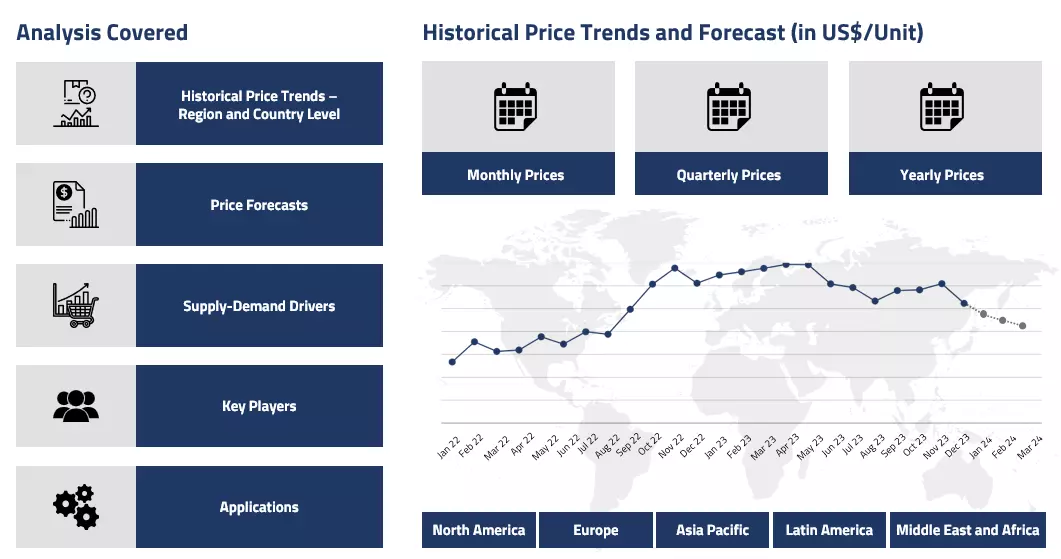
Please Login or Subscribe to Access the Cassava Price Chart Data
As China shifted its industrial processing inputs, Vietnamese exporters faced lower volumes and prices, resulting in financial strain for farmers and traders. Processing factories in Tay Ninh also relied heavily on imports from Cambodia due to limited domestic supply, but this did little to improve overall market sentiment.
In Thailand, although cassava production declined due to adverse weather and disease outbreaks, prices remained firm. The supply shortage supported farmer income, and growing demand from ethanol and food sectors helped keep the market stable. However, disease pressure and rising input costs remained key concerns for Thai growers.
Africa
In Nigeria, the cassava sector struggled during H1’25. Prices fell drastically as local processors halted purchases due to a surge in cheap starch imports—mostly corn-based—brought in under zero-duty policies. This undercut local cassava starch producers who were forced to reduce operations or shut down.
Farmers, who had planted cassava expecting steady industrial demand, were left with limited options, relying mainly on low-paying traditional processors. The situation triggered panic among both processors and growers, many of whom had invested heavily in the crop expecting continued industrial demand.
Analyst Insight
According to Procurement Resource, Cassava prices may see limited recovery later in 2025 if industrial demand stabilizes and weather conditions improve, but market uncertainties linked to global feed trends, trade policies, and climate impacts remain a challenge.
Cassava Price Trend for the Year of 2024
Asia
In 2024, the cassava market in Asia exhibited varied trends across different countries. Thailand took proactive steps to stabilize prices through government subsidies and enhanced storage systems, ensuring consistent price levels. Meanwhile, Cambodia saw an increase in cassava exports, but the higher supply led to downward pressure on local prices.
Despite this, strong processing activity in Thailand and Vietnam helped to maintain stability in the market, supporting prices amid the abundant supply.
Africa
In Africa, particularly in Uganda and its neighboring countries, market conditions were more difficult. Oversupply in local markets, coupled with reduced demand from key export destinations, led to a decline in prices. Many farmers faced significant drops in prices compared to the previous year, which led some to consider switching to alternative crops. Limited infrastructure and challenges in local processing capacity further exacerbated the situation, making it a difficult year for many producers.
South America
In South America, Brazil experienced a surge in cassava prices due to tight supply and strategic management of deliveries. The region benefitted from strong industrial demand and steady sales in both wholesale and retail markets. Processing industries in Brazil maintained consistent procurement levels, which helped support the upward price momentum throughout 2024.
Analyst Insight
According to procurement resources, not much change is anticipated in the cassava price trends in the coming months as well since the supply and demand dynamics are not suggesting many fluctuations.
Cassava Price Trend for the Second Half of 2023
| Product | Category | Region | Price | Last Updated Month |
| Cassava | Food and Beverages | South America | 144.8 USD/MT | July'23 |
| Cassava | Food and Beverages | South America | 116.37 USD/MT | Dec'23 |
Stay updated with the latest Cassava prices, historical data, and tailored regional analysis
Asia
The spread of cassava mosaic disease and cassava witches' broom disease threatened the Asian cassava plantations, impacting over 3.5 million hectares. CMD, introduced through Cambodia, rapidly affected plantations across mainland Southeast Asia, reducing yields by up to half and disrupting the cassava supply chain.
To combat the diseases, researchers focused on multiplying healthy cassava stems and developing disease-resistant varieties. While these efforts provided only short-term relief, and in view of concerns over the quality of produce, consumer confidence in this sector has declined. The loss of consumer interest in the sector eventually resulted in the downfall of the cassava price trend during the third and fourth quarters of 2023.
South America
The Amazon rainforest faced its worst drought in the later quarters of 2023, leading to severe repercussions such as unreachable villages, wildfires, and wildlife fatalities. The drought's impact on communities like Bom Jesus de Igapo Grande was drastic, and with spoiled crops such as Brazilian cassava, the spot prices dipped from approximately 144.8 USD/MT (FD) in July to around 116.37 USD/MT in December '23. The El Niño weather pattern, compounded by climate change, is exaggerated by the supply situation, with abnormal warming in the Pacific and North Atlantic oceans contributing to hot, dry conditions in the Amazon.
Analyst Insight
According to Procurement Resource, the price trend of cassava is expected to take on a foul turn as the decline in production and constriction in consumer budget will exert a negative influence on the market.
Cassava Price Trend for the First Half of 2023
Asia
The first half of 2023 turned out to be really good for Asian Cassava producing countries like Vietnam and Cambodia. The year 2023 witnessed a good yield of cassava crops. As global trade started opening up in the post-pandemic era and supply chains improved with improved transportation mediums, end-consumer demands for Cassava saw a rise. China was one of the major importers of Cassava from these countries. Overall, very positive market sentiments were observed for Cassava prices in H1 2023.
South America
South American Cassava market, though, behaved totally differently. Cassava started fine in Brazil and experienced inclined price trend in January. New orders were being received, and the projections looked good, but an unanticipated competition appeared in exporting the root vegetable.
Asian Cassava producing countries, too, saw record crop yields, so the market had excess supplies. So as the export queries declined, the price trend for Cassava turned south in the Brazilian market from February and declined consistently throughout the rest of the concerned period. But because domestic consumption in Brazil was still significant, the cassava market stayed afloat.
Analyst insight
According to Procurement Resource, the price trend for cassava are expected to continue behaving in a similar manner in the upcoming months as well, primarily because market demands from consuming nations will continue to drive the cassava price trend.
Cassava Price Trend for the Second Half of 2022
Asia
The cassava prices displayed diverse trend throughout the Asia-Pacific region. In India, cassava prices increased averaging 40 INR/kg. The cassava prices did not increase for the past two years, hence many producers stopped production and shifted to other products for larger profits. However, this year the demand rebounded in the domestic market causing the prices to inflate as the inventories ran dry. In Cambodia, the cassava prices averaged 370-420 rivels/kg (0.096 USD/kg).
Africa
The cassava price averaged 30,000 Naira/MT ( or 67.80 USD/MT ) in Nigeria during the third quarter period. Owing to the high input costs, the market supply of cassava declined. Since cassava is a household staple in Africa, shortages amid solid demand caused the prices to incline.
Latin America
The price trend for cassava kept steadily rising in the Brazilian market throughout the said period. The prices went from 167.84 USD/MT in July to 227.72 USD/MT ( Spot FD Brazil) ( approx.) in December 2022. The inclined prices were the result of high demand and lowered supply owing to harvest losses caused by unfavourable weather conditions.
Analyst Insight
According to Procurement Resource, the prices of cassava are expected to remain high owing to volatilities in the market. The poor yields due to intermittent rainfall and farmers switching to other crops for better profits together reinforced these high prices along with potent demand.
Cassava Price Trend For the Second Quarter of 2022
Asia
Thailand, Cambodia, and Vietnam are the key exporters of the tuber in the Asian region. Chinese cassava imports account for around 36.5% of the global imports. However, in the current quarter, the price trend of the tuber dipped due to various reasons.
Firstly, many farmers in Thailand switched to planting rice due to better pricing and the demand from the Chinese market declined. To prevent the stockpiling of corn in the domestic market, the Chinese government directed the manufacturers to use corn instead of cassava in feed production. The price of Thai cassava averaged 2.1-2.2 THB/kg in the market.
Latin America
Cassava forms an essential part of the diet in Brazilian households. Brazilian cassava prices averaged 1.43-1.17 USD/kg or around 1430 USD/ton.
Middle East and Africa
The price trend of the tuber remained firm in the African market. Despite being the largest producer, African exports are limited as most of the product is consumed domestically. Domestic productions help achieve food security and provide recurring income to the farmers.
Cassava Price Trend For the First Quarter of 2022
Asia
As the global demand for cassava increases, Thailand’s cassava market is projected to prosper amid rise in cereal prices. In March 2022, the price of fresh cassava root was around 2.5-2.6 THB/kg. The cassava prices are projected to increase with an increase in demand. The global cassava root production is expected to increase to 302 MMT. Thailand has an estimated domestic demand of 12.7 MMT for cassava root while exports are estimated at 29.7 MMT.
Latin America
Cassava root prices were in the range of 153-163 USD/MT in Brazil in the final week of March.
Cassava Price Trend For the Fourth Quarter of 2021
Asia
In the fourth quarter of this year, Thailand's Industry and Trade Information Center raised the value floor of cassava flour from 475 USD/MT to 480 USD/MT, resulting in a price increase from 0.41 USD/kg to 0.42 USD/kg. Other merchants, such as the Thai Yam and Tapioca Factories Association, increased the price of exported chips by 0.5 USD/kg at the same time. On the other hand, raw cassava prices remained steady at roughly 0.075-0.080 USD/kg.
Europe
In December 2021, tuber prices in the United Kingdom were projected to be between 1220 USD/MT and 1290 USD/MT. Cassava starch was frequently used in the textile industry for finishing, sizing, and printing because of its flexibility, abrasion resistance, and ability to create a link with the fibre.
Latin America
In the fourth quarter of 2021, the tuber market price in Brazil gradually increased, reaching 124 USD/MT in December, from 102 USD/MT in October. After a period of low productivity, cassava prices increased as demand grew.
Cassava Price Trend For First, Second and Third Qaurters of 2021
Asia
The tuber’s business grew as a result of urbanisation, increased working population, and rising family incomes, while the global food sector expanded significantly, particularly in emerging economies like India and China. This aided the growth of the industry by raising demand for ready-to-eat foods.
Latin America
For the first three quarters of 2021, the average Brazilian market prices of the tuber were in the range of 78-102 USD/MT. Since the tuber is a well-established product in South American countries, consumption patterns and total market demand were steady. Latin America's population growth, as well as expanding food industry demand, were the key drivers of the market in 2021.
Cassava Price Trend For the Year 2020
Asia
In 2020, the cassava market price in Vietnam was roughly 94 to 98 USD/MT, while the price range in Indonesia was 68 to 72 USD/MT. Thailand ranked fifth in exports in 2020, with a 6.32 percent global share, a value of USD 5.77 million, and a volume of 4.84 MT. It was ranked 19th in 2020 imports, with a 0.46 percent share valued at USD 578.19 thousand and a volume of 92.96 thousand MT.
Europe
Average manioc import prices in the United Kingdom were 1170 USD/MT in the start of 2020. Manufacturers were attempting to develop and invent clean-label meals and food ingredients, which increased demand for wheat as a natural product in the worldwide food and beverage industries. Technological developments, industrial expansion, and increased population growth fueled global demand for flour.
North America
Manioc starch prices in the United States were 668 USD/MT in January, 640 USD/MT in February, and 692 USD/MT in March of 2020. The global cassava flour market expanded as a result of rising consumer desire for a healthy lifestyle, which led to increased consumption of healthy food products and food ingredients. Furthermore, market expansion was fueled by increased demand for packaging innovation, convenience meals, and an expanding population willing to pay a premium for healthy food.
Latin America
Cassava prices in Brazil fell from 114 USD/MT in January to 82 USD/MT in February, and then to 76 USD/MT in March of 2020. While prices rose to 100 USD/MT in October, they fell down to 87 USD/MT in November and stayed rangebound until the end of the year. Government-imposed lockdowns and transportation restrictions hampered various food industries, causing the market to suffer from a drop in demand and consumption.
Procurement Resource provides latest prices of Cassava. Each price database is tied to a user-friendly graphing tool dating back to 2014, which provides a range of functionalities: configuration of price series over user defined time period; comparison of product movements across countries; customisation of price currencies and unit; extraction of price data as excel files to be used offline.
Our Clients


Procurement Resource Database

Turn price intelligence into action with the Procurement Resource Database. Log in or subscribe to unlock live price trends, historical charts, supplier databases, cost curves, and analyst-backed insights across chemicals, agriculture, energy, packaging, and more. Use these tools to benchmark your contracts, plan budgets with confidence, and stay ahead of market moves on every product you buy.
Cassava Dashboard Inclusions

0
+Products
0
+Regions
0
+Subscriptions
About Cassava
Cassava is a woody shrub which is native to South America and belongs to the spurge family, Euphorbiaceae. Although a perennial plant, Cassava is widely cultivated as an annual crop in tropical and subtropical regions owing to its edible starchy tuberous root, which is one of the richest sources of energy (carbohydrates).
Cassava is mostly consumed in boiled form; however, its substantial quantities are utilised to extract cassava starch. Its starchy roots can also be processed into cassava chips, cassava flour, and cassava pellets. Further, it is the third most significant crop of the tropical region after rice and maize.
Cassava Product Details
| Report Features | Details |
| Product Name | Cassava |
| Synonyms | Manihot esculenta, Manioc, Yuca, Macaxeira, Mandioca, kappa kizhangu |
| Industrial Uses | Alcoholic Beverages, Culinary, Animal Feed, Biofuel, Glues and adhesives, Paper and cardboard, Textiles, Pharmaceutical |
| Supplier Database | Dadtco Philafrica B.V, Avebe U.A, Tereos, Cargill, Incorporated, Ingredion Incorporated, Emsland Group, Alvan Blanch Development Company Limited |
| Region/Countries Covered | Asia Pacific: China, India, Indonesia, Pakistan, Bangladesh, Japan, Philippines, Vietnam, Iran, Thailand, South Korea, Iraq, Saudi Arabia, Malaysia, Nepal, Taiwan, Sri Lanka, UAE, Israel, Hongkong, Singapore, Oman, Kuwait, Qatar, Australia, and New Zealand Europe: Germany, France, United Kingdom, Italy, Spain, Russia, Turkey, Netherlands, Poland, Sweden, Belgium, Austria, Ireland Switzerland, Norway, Denmark, Romania, Finland, Czech Republic, Portugal and Greece North America: United States and Canada Latin America: Brazil, Mexico, Argentina, Columbia, Chile, Ecuador, and Peru Africa: South Africa, Nigeria, Egypt, Algeria, Morocco |
| Currency | US$ (Data can also be provided in local currency) |
| Supplier Database Availability | Yes |
| Customization Scope | The report can be customized as per the requirements of the customer |
| Post-Sale Analyst Support | 360-degree analyst support after report delivery |
Note: Our supplier search experts can assist your procurement teams in compiling and validating a list of suppliers indicating they have products, services, and capabilities that meet your company's needs.
Cassava Production Process
- Production of Cassava via Cultivation: Being one of the most drought-tolerant crops, Cassava is capable of growing on marginal soils. After the cultivation and maturing of Cassava, it is harvested by hand. The upper parts of the stems containing leaves are plucked off before harvest. The method involves the raising of the stem’s lower part and pulling the roots out of the ground. These roots are then separated from the base of the plant to obtain Cassava roots.
Methodology
The displayed pricing data is derived through weighted average purchase price, including contract and spot transactions at the specified locations unless otherwise stated. The information provided comes from the compilation and processing of commercial data officially reported for each nation (i.e. government agencies, external trade bodies, and industry publications).
Our Price Analysis Methodology


Schedule A Demo
Experience how Procurement Resource transforms raw material price data into clear, decision ready intelligence. Optimise your performance with reliable, expert market data and analysis. Schedule your demo today to experience a live walk-through where our experts will showcase interactive price charts, forecasted prices, and insights driving the prices for your key commodities, tailored to your workflows. Contact us now!
Our Team will be happy to assist you
We are just a text away
Still Need Help ?
Europe & Africa
+44 7573 171117
Sales@prourementresource.com
USA & Canada
+1 307 363 1045
Sales@prourementresource.com
APAC
+91 8850629517
Sales@prourementresource.com
Other Related Reports
Cassava Starch Production from Wet Milling
This report provides the cost structure of cassava starch production from the wet milling process. In this process, cassava roots are peeled and washed before being grated.
Subscription Plans
Unlock full access to Procurement Resource's price databases, interactive charts, and short-term forecasts for thousands of commodities. Elevate your sourcing decisions by comparing prices across regions, downloading historical data, and layering in analyst-backed insights, all with our flexible plans that scale as your portfolio grows.
Still have any Questions
Contact Us


Price Trend Dashboard - What's Included
Price trends across a diverse portfolio of categories and products, spanning board to niche chemicals
Coverage extendable to grade-specific chemicals based on procurement requirements
Regular price tracking supported by robust historical datasets
News, policy updates, and key market drivers impacting price movements
Short-term and long-term price outlooks and forecasts
Supply–demand dynamics and capacity-driven market analysis
- Unlimited Users
- Historical Monthly Price
- USA, Europe, APAC Covered
- Monthly Forecast
- 12 Months validity
- News & Events
- 50 Products (Refer Next Page For List)
Related News
View All

Why Procurement Database

Assistance from Experts
Throughout 2024, the Asian acetoin market experienced fluctuating trends with regional variations. Q1 began with moderate price increases driven by supply constraints from Chang Chun Plastics' maintenance shutdown in Taiwan. Post-S...

Client's Satisfaction
Throughout 2024, the Asian acetoin market experienced fluctuating trends with regional variations. Q1 began with moderate price increases driven by supply constraints from Chang Chun Plastics' maintenance shutdown in Taiwan. Post-S...

Assured Collaboration
Throughout 2024, the Asian acetoin market experienced fluctuating trends with regional variations. Q1 began with moderate price increases driven by supply constraints from Chang Chun Plastics' maintenance shutdown in Taiwan. Post-S...
Global Insights
Throughout 2024, the Asian acetoin market experienced fluctuating trends with regional variations. Q1 began with moderate price increases driven by supply constraints from Chang Chun Plastics' maintenance shutdown in Taiwan. Post-S...
1/4